A cover letter is the first thing a recruiter sees, even before opening your CV. For a seafarer it is usually a short message in the body of the e-mail: a few lines about who you are, which position you are applying for and when you can join. The CV goes in the attachment. A good letter raises the chance that the attachment is opened at all.
Does a seafarer need a cover letter?
There is no strict rule, and many agencies accept a CV without a letter. But a letter works in your favour for three reasons. First, the recruiter sees your English: if you write clearly and without mistakes, that is already a partial answer to the main question about language. Second, a letter lets you highlight what matters for this vacancy: experience on the required vessel type, endorsements, readiness to join at once. Third, it shows that you write deliberately rather than send the same file to every address.
A letter does not replace the CV and does not retell it. Its job is to push the recruiter to open the CV and to convince them that you fit.
Where to put the letter
The most convenient option is to write the text directly in the body of the e-mail and attach the CV as a single PDF file. The recruiter reads the letter in the mailbox without opening a separate file. Sending the letter as a second attachment (Word or PDF) is not recommended: it will most likely not be opened. If an agency asks for the cover letter as a separate file, follow their requirement.
Structure: six parts
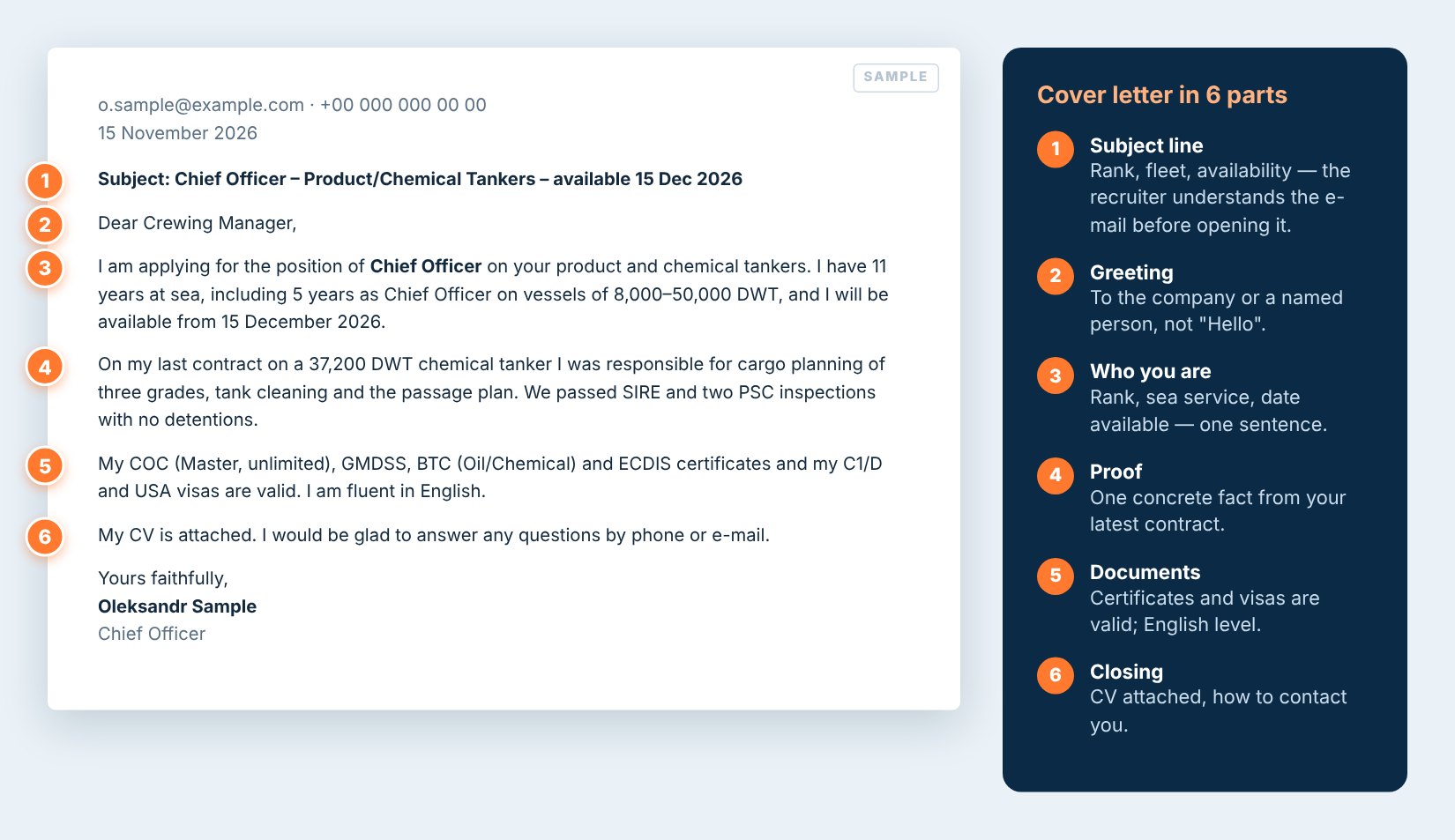
- Subject line. Rank, fleet, your surname and date available. The recruiter understands what the e-mail is about before opening it.
- Greeting. "Dear Crewing Manager" or "Dear Sir/Madam". If you know the name of the specialist for your rank, address them by name: it makes the letter stand out at once.
- Who you are. One sentence: rank, total sea service, time in rank, date available.
- Proof from experience. One or two concrete facts about your last contract or an important stage of your career: vessel type and size, cargoes, inspection results.
- Documents. Certificates and visas are valid; English level.
- Closing. CV attached, how to contact you, readiness for an interview.
Length and tone
The best length is 120–180 words, four or five short paragraphs. The letter should be readable in 30 seconds on a phone screen. Write in simple sentences: the recruiter needs clarity, not literary style. Keep the tone businesslike and calm, with no pleading and no boasting. Phrases like "I kindly beg you", "I will be extremely grateful" or "I am the best candidate" are not needed.
Sample letters for different ranks
Below are three templates for different rank groups. Replace the data with your own and do not copy the wording as it is: recruiters see identical letters dozens of times.
Chief Officer
Subject: Chief Officer / Tankers / Sample Oleksandr / available 15.12.2026
Dear Crewing Manager,
I am applying for the position of Chief Officer on your product and chemical tankers. I have 11 years at sea, including 5 years as Chief Officer on vessels of 8,000–50,000 DWT, and I am available to join from 15 December 2026.
On my last contract on a 37,200 DWT chemical tanker I was responsible for cargo planning of three grades, tank cleaning and the passage plan. The vessel passed SIRE and two PSC inspections with no detentions.
My COC (Master, unlimited), GMDSS, BTC (Oil/Chemical) and ECDIS certificates and my C1/D and USA visas are valid. I am fluent in English.
My CV is attached. Please contact me by e-mail or WhatsApp/Telegram at +00 000 000 00 00.
Yours faithfully,
Oleksandr Sample
Second Engineer
Subject: Second Engineer / Bulk carriers / Sample Andrii / available 01.12.2026
Dear Sir/Madam,
I would like to apply for the position of Second Engineer on your bulk carriers. I have 8 years of sea service, 3 of them as Second Engineer on vessels of 30,000–82,000 DWT with MAN B&W main engines.
On my last vessel I was in charge of the main engine and boiler maintenance and of the planned maintenance system; the vessel was operated with a UMS notation. I hold a valid COC (Second Engineer, unlimited), ERM and High Voltage certificates.
I am available from 1 December 2026. My CV is attached, and I can be reached by e-mail or phone at +00 000 000 00 00.
Best regards,
Andrii Sample
Able Seaman
Subject: Able Seaman / Container ships / Sample Dmytro / available now
Dear Crewing Manager,
I am an Able Seaman with 6 years of sea service on container ships of 4,000–8,000 TEU and I am available to join immediately.
My duties included deck watchkeeping, mooring operations, lashing and maintenance. My AB certificate, basic STCW courses, medical certificate and C1/D visa are valid until 2028. My English is at working level.
My CV is attached. I can be reached by WhatsApp or phone at +00 000 000 00 00.
Kind regards,
Dmytro Sample
Note what all three letters have in common: the rank in the first line, concrete experience, the date available, valid documents and contacts. There is no story about character and dreams, no pleading and no general words.
What not to write in a cover letter
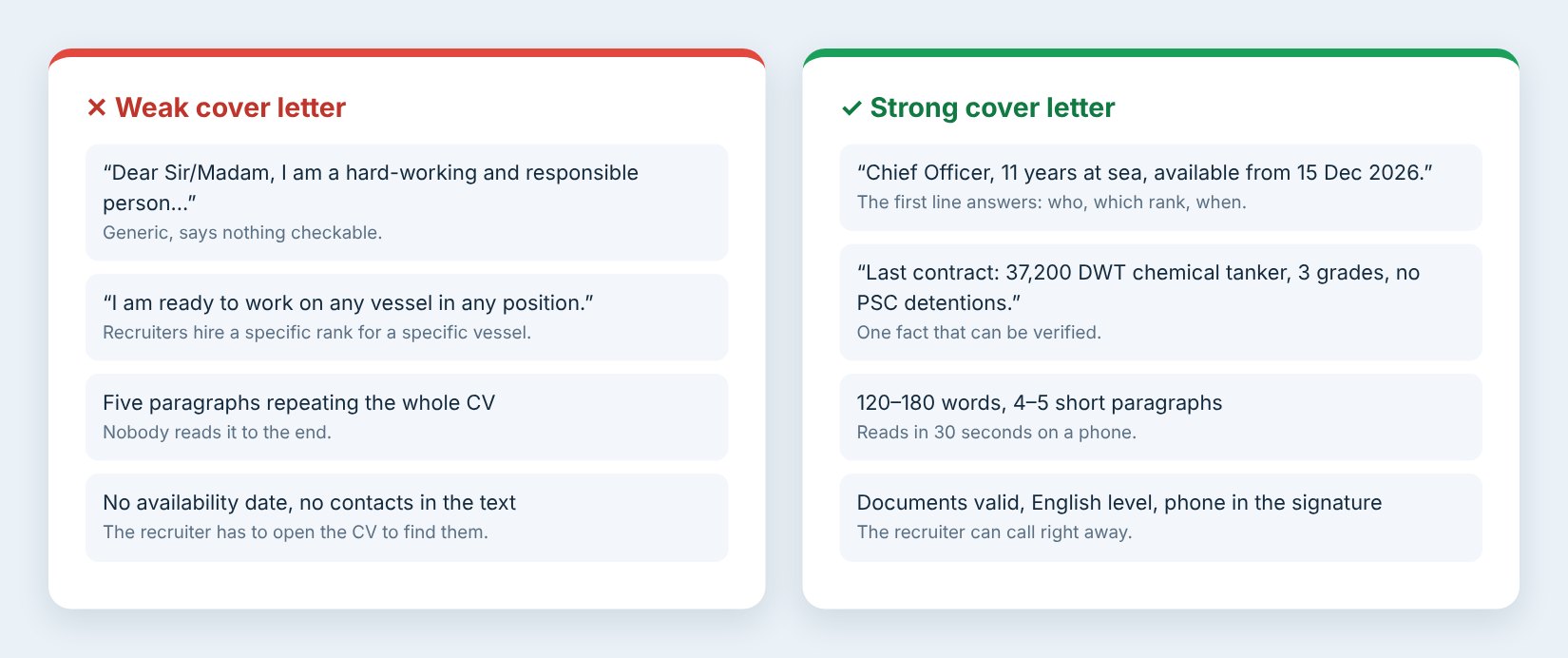
- General phrases. "Responsible, hard-working, stress-resistant" proves nothing. A fact is better: "5 years on chemical tankers, no PSC detentions".
- "Ready for any position". A crewing agency selects a specific rank for a specific vessel.
- Complaints about a previous company. Even if there are grounds, a letter is not the place.
- Salary expectations unless they were requested. Discuss pay at the interview.
- Personal circumstances: marital status, problems, reasons for leaving a previous job.
- A copy of the whole CV. The key facts are enough in the letter.
- A template greeting with someone else's company name. If you mix up the agency's name, the letter goes to the bin.
How to tailor the letter to the vacancy
If you are replying to a specific vacancy, state it in the first line: "I am applying for the position of Chief Officer on your chemical tanker (ref. 123)". Then show in one sentence that your experience matches the requirements: the same vessel type, comparable tonnage, the required endorsements. If the vacancy asks for several things, name the ones you have. Do not invent what is missing: it quickly comes out at the interview.
If you are writing to an agency not about a specific vacancy but to join their database, write a universal letter with your rank, vessel types and date available. Such a letter can be used for mailing, changing only the company name.
Signature and contacts
At the end give your name, rank, phone and messenger. Do not make the recruiter search for contacts in the CV. Add a link to your LinkedIn profile if it is complete and up to date. Your e-mail address should look professional.
Mistakes in the letter and how to avoid them
- Read the letter aloud: mistakes and clumsy phrases are easier to hear than to see.
- Check the names: company, rank, vessels. One wrong letter looks careless.
- Do not write in capital letters or use many exclamation marks.
- Do not paste pictures and fancy fonts into the body: it may display incorrectly.
- Make sure the attachment is attached and that it is the right version of the CV.
What to do after sending
If there is no reply, remind them after 7–10 days with a short message in the same thread: "I would like to follow up on my application dated... I remain available from...". Do not write every day and do not send the same letter several times in a row: it is perceived as spam. More about this in "How to e-mail crewing agencies".
If you would rather not write letters yourself
For seafarers who are not sure about their English or do not want to spend time, we write a cover letter for your rank and vessel types — order a CV and cover letter. For the CV itself, see "How to write a seafarer CV" and the guide to how recruiters read a CV.
Frequently asked questions
Do I need a cover letter when I send a seafarer CV?
It is not mandatory but it helps: it shows your English, lets you highlight what matters for the vacancy and raises the chance that your CV is opened.
How long should a seafarer's cover letter be?
About 120–180 words, four or five short paragraphs. It should be readable in 30 seconds on a phone screen.
What language should I write the letter in?
English. It is the working language of the maritime industry, and the letter shows your language level at the same time.
Is it better to send the letter in the e-mail body or as an attachment?
In the body of the e-mail, with the CV as a separate PDF attachment. Recruiters often do not open a separate letter file.
Should I state my expected salary?
Usually not. If the agency directly asks for expectations, answer briefly in the letter without rigid figures and discuss the details at the interview.