An e-mail to a crewing agency is your first business impression. The recruiter does not know you, has not seen your documents and spends only seconds on an e-mail. A clear subject, a short text and a properly named file raise the chance that your CV is opened and you get a call. Below is a step-by-step guide from preparation to the follow-up, together with the typical mistakes that make e-mails not arrive or stay unanswered.
What to prepare before sending
- An up-to-date CV as a PDF. With the date available, certificate expiry dates and contacts. How to build it is explained in "How to write a seafarer CV".
- A short e-mail text in English. One universal template for your rank and several variants for fleets (tankers, bulk carriers, offshore).
- A list of addresses. E-mails of recruitment departments (crewing, recruitment, manning). It is better to take addresses from companies' official websites than from random databases.
- A professional mailbox. An address like name.surname@…, a signature with contacts and a place to store replies.
- A tracking table. To note whom you wrote to and when.
1. The subject line
The subject should hold everything important: rank, fleet, surname and name, date available. The recruiter sees it in the inbox list and decides whether to open the e-mail.
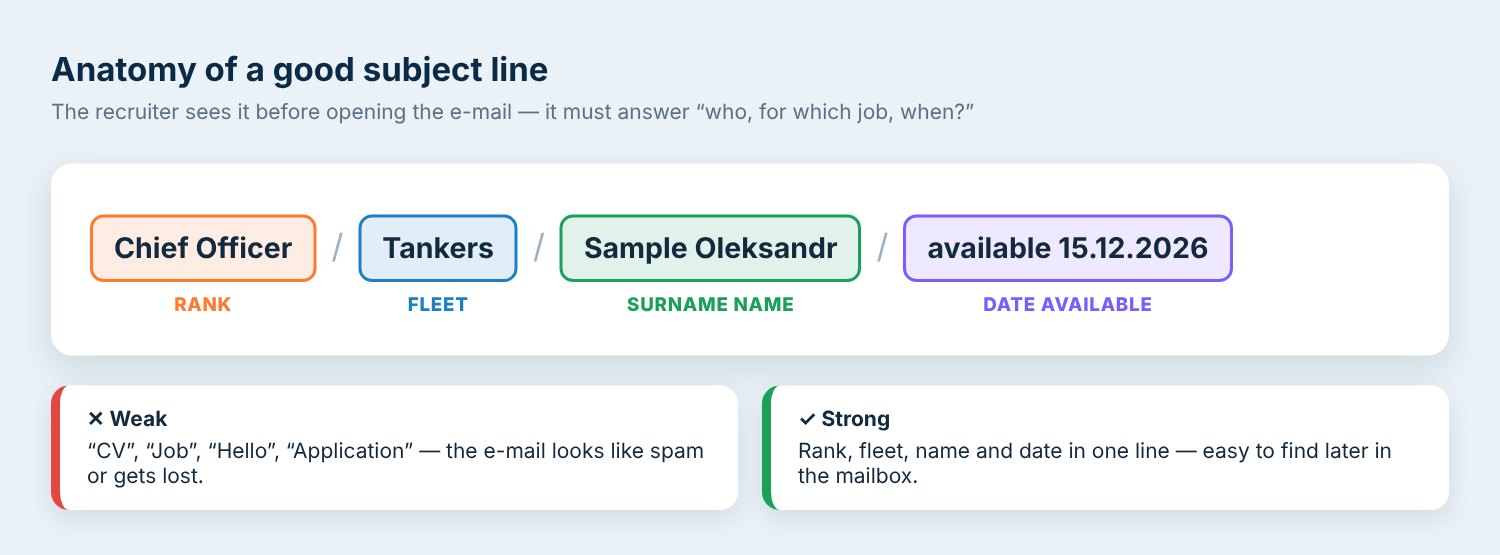
Example: Chief Officer / Tankers / Ivanov Dmytro / available 30.11.2026. This subject answers "who", "for which rank" and "when" before the e-mail is opened. Weak subjects: "CV", "Job", "Application", "Hello". They get lost among hundreds of similar e-mails, and some mail filters treat them as spam.
2. The e-mail text
Three to five sentences in English: who you are, the rank, your main experience and the date available. The CV goes in the attachment. End with your phone and messenger.
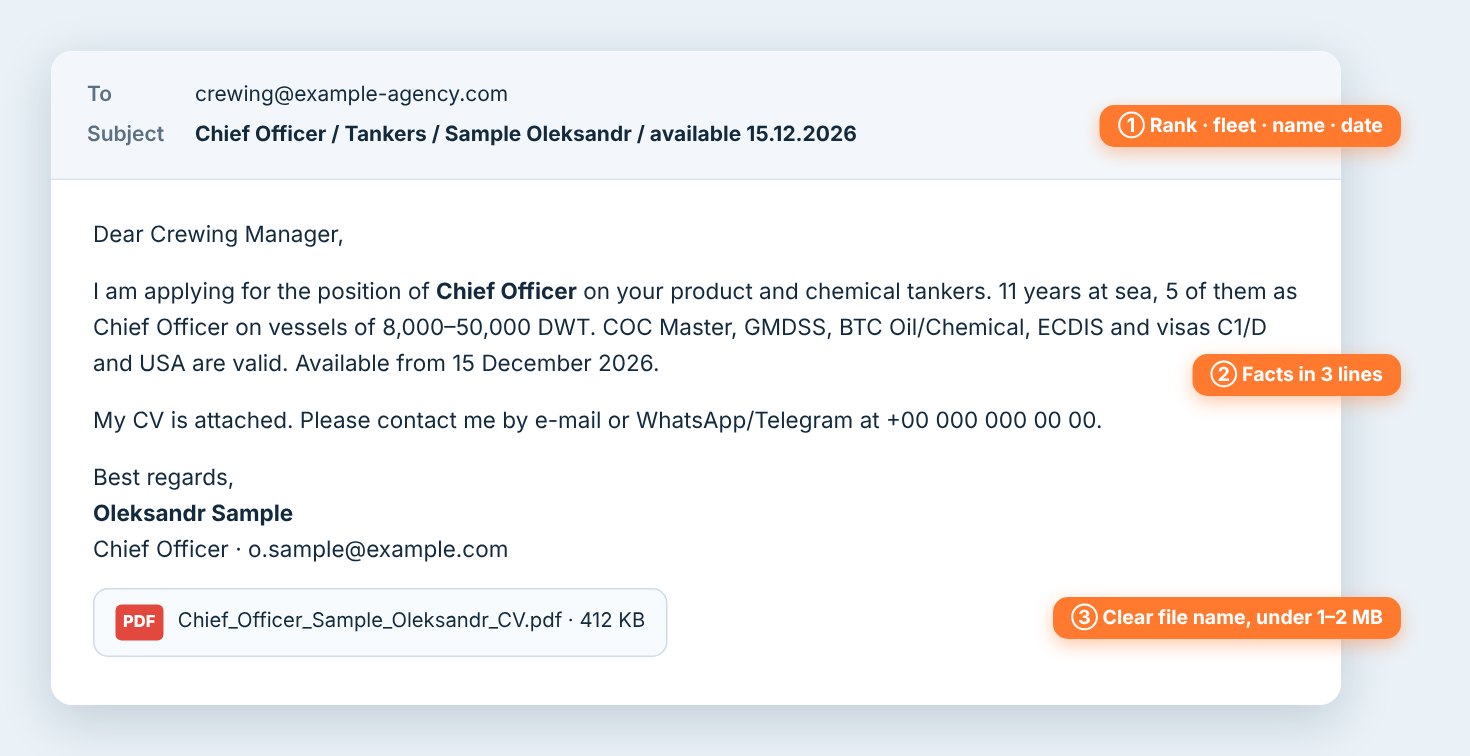
What a letter consists of and how to adjust it to a vacancy is described in detail in "Cover letter for seafarers". The main thing to remember here: a short e-mail gets read, a long one gets closed.
3. The attachment
- One PDF file. The CV with no extra attachments.
- A clear name. Chief_Officer_Ivanov_CV.pdf, not "cv", "new_resume" or "scan001".
- A small size. Up to 1–2 MB: heavy e-mails pass filters worse and open slowly on a phone.
- Certificates and document copies are sent separately and only if requested. Extra attachments make the e-mail heavier and raise the risk of landing in spam.
- The text in the PDF should be selectable, not an image, so the CV can be found in the database by keywords.
4. To whom and how to send
Write to each agency in a separate e-mail to a single address. Do not send one e-mail to a hundred addresses in copy: recipients see others' addresses, the e-mail more often lands in spam and it looks unprofessional. If the same text goes to many, change at least the greeting and the company name. Check that the agency's name is spelled correctly.
If the company's website has a form for seafarers, fill it in: it is the channel that is checked first. You can additionally send an e-mail to the recruitment department, but do not duplicate the same thing several times a day.
5. When to send
Preferably on a weekday during the agency's working hours. Mind the time zone: an e-mail that arrives in the morning in the agency's time is more often read at once. E-mails sent at night or at the weekend end up at the bottom of the inbox by the start of the working day. If you write to many, spread the sending over several days instead of sending everything in an hour.
6. How to avoid spam folders
- Use a normal mailbox, preferably with your name.
- Do not write the subject in capital letters or with exclamation marks.
- Do not put many links and pictures in the body.
- Do not send hundreds of identical e-mails in a short time from one free mailbox: it may be blocked.
- Avoid words like "urgent", "guarantee", "free" in the subject.
- Check that there are no infected attachments or links to doubtful sites in the e-mail.
7. The follow-up
If there is no reply, remind them after 7–10 days with a short message in the same thread. Example:
Dear Crewing Manager,
I would like to follow up on my application of 15 November for the position of Chief Officer. I remain available from 15 December 2026, and my CV is attached again for your convenience.
Best regards, Oleksandr Sample, +00 000 000 00 00
Do not write every day and do not send the same e-mail several times in a row: it is perceived as spam. After the second reminder move on to other agencies and come back in a couple of months with an updated CV.
Templates for different situations
We covered the main e-mail above. But there are other cases: you answer a specific vacancy or update your data in an agency's database. Below are two short templates; replace the data with your own.
Replying to a vacancy
Subject: Reply to vacancy: Second Engineer, chemical tanker / Sample Andrii / available 01.12.2026
Dear Crewing Manager,
I am replying to your vacancy for a Second Engineer on a chemical tanker. I have 3 years in rank on MAN B&W engines, valid COC, ERM and High Voltage certificates, and I can join from 1 December 2026. My CV is attached. I am available by phone and WhatsApp at +00 000 000 00 00.
Best regards, Andrii Sample
The subject names the vacancy and the text shows the match with the requirements: time in rank, engine, certificates and joining date. Quote the vacancy number if the announcement has one.
Updating your data
Subject: Update: Chief Officer / Tankers / Sample Oleksandr / available 15.12.2026
Dear Crewing Manager,
I am sending my updated CV: I have completed my latest contract as Chief Officer on a 37,200 DWT chemical tanker and renewed my ECDIS and BTC certificates. I am available from 15 December 2026.
Best regards, Oleksandr Sample, +00 000 000 00 00
An update is useful when your contract has ended, your date available has changed or you have received a new certificate. For the recruiter it is a sign that you are still searching and ready to work.
How to answer when someone writes to you
- Reply the same day, preferably within an hour: vacancies close fast.
- If they ask for documents, send only what was requested, in the required format.
- If they ask you to fill in a form on the website, do it at once and confirm by e-mail.
- If they call and you cannot answer, call back or write in the messenger.
- Do not agree to paid "employment" services: under MLC 2006 a seafarer does not pay for that.
Records and re-sending
Note in a table the sending date, agency name, address, CV version and reply. It protects you from double e-mails, tells you whom to remind and shows which agencies reply. If your date available, certificates or contacts have changed, send an updated CV: the old one in the agency's database may be misleading.
Typical mistakes
- A subject like "CV" or an empty subject. The e-mail gets lost.
- A long text about yourself. The recruiter does not finish it.
- No rank or date available. It is unclear whom you offer and when.
- A file with an unclear name or Word instead of PDF. Layout errors may appear.
- Many recipients in copy. You reveal others' addresses and raise the spam risk.
- The wrong company name in the greeting. The e-mail looks like a template mailing.
- No contacts in the text. The recruiter has to look for them in the CV.
If you need to write to many agencies
Writing by hand to five or ten agencies is realistic. But if you want to reach hundreds of companies, you need an address database, templates with company names filled in, and time for sending and record keeping. All of this can be handed to CV-Sender mailing: each e-mail goes out separately on the day and at the time you choose, and replies come to your personal account and your mailbox. If you need to prepare your documents first, we will write a CV and cover letter for your rank. More ideas on search channels are in "Where to find seafarer jobs".
Frequently asked questions
What should I put in the subject line of an e-mail to a crewing agency?
Rank, fleet, surname and name, date available. For example: Chief Officer / Tankers / Ivanov Dmytro / available 30.11.2026.
How often can I write to a crewing agency?
The first e-mail with the CV, a reminder after 7–10 days. After that it is better to pause for a couple of months or write when your date available or documents change.
Should I send copies of certificates together with the CV?
Usually not. Send one PDF with the CV and send scans of documents only if they are requested.
Can I send one e-mail to many agencies at once?
It is better to send a separate e-mail to a single address. An e-mail to a hundred addresses in copy looks unprofessional and more often lands in spam.
What time is best to send the e-mail?
On a weekday during the agency's working hours, taking its time zone into account. Morning e-mails are read most often.