Jobs on ships are found in different ways: some people return to the same company, some get an invitation from a captain they know, and some have to search from scratch. If you are looking for a job, a single channel almost never gives a result: vacancies are posted in various places and some of them close within days. Below are six main sources, how to use them and how to avoid scammers.
Where seafarer vacancies usually appear
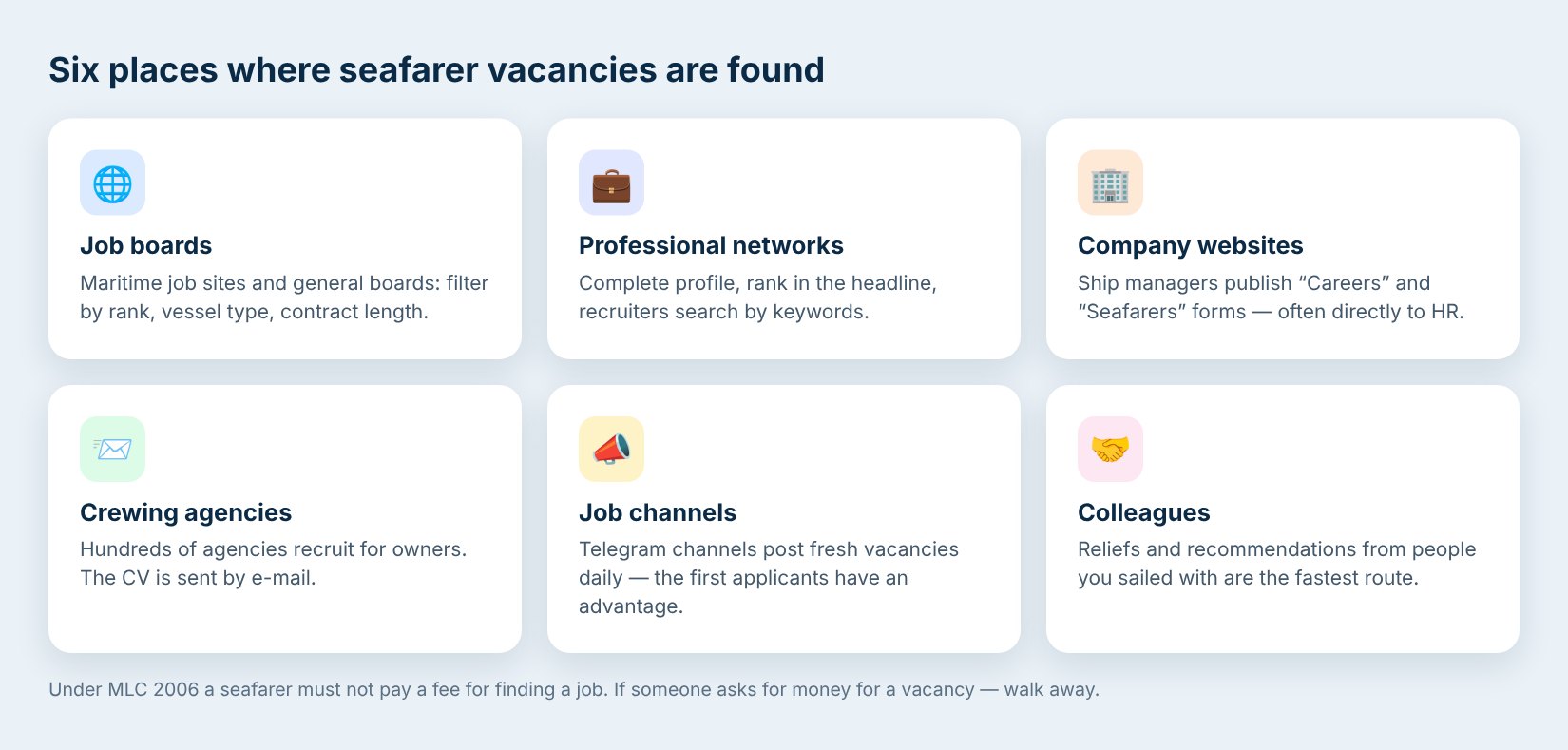
1. Job boards and professional networks
This is the most obvious route: you create a profile, upload your CV and apply to vacancies or wait to be found.
- LinkedIn is the biggest professional network: recruiters search for seafarers by rank and experience. Put your rank in the headline (for example "Chief Officer | Tankers | Available from December"), list vessel types and certificates and switch on "Open to work".
- Maritime Zone is a maritime portal with vacancies and specialist profiles.
- Crewell is a platform for finding jobs on ships.
- Indeed is a general job site that also lists maritime positions.
Platform terms change, so before registering check what is free and what is paid. Your profile on each site must match your CV: the same dates, the same vessel names and the same certificates. A mismatch between profile and CV creates distrust.
2. Shipping company websites
Many shipowners and ship managers have a Careers or Seafarers section with an application form for seafarers. Filling it in is a direct application to the HR department. The downside is that anyone can apply and an answer does not always come. The upside is that you get into the company's own database and may be invited when a suitable vacancy appears. Choose 10–15 companies you would like to work for (by vessel type, flag, conditions) and follow their pages.
3. Crewing agencies
A crewing agency selects crews for shipowners. It is one of the main hiring channels for seafarers worldwide. There are many agencies, each with its own specialisation: tankers, bulk carriers, offshore, passenger fleet. CVs are usually sent by e-mail to the recruitment department. To work effectively you need to write to several dozen agencies, each one personally and with a proper subject line. How to do it is explained in "How to e-mail crewing agencies".
How to recognise a reliable agency. Under the international MLC 2006 convention a seafarer must not pay for finding a job, and recruitment agencies must be registered and licensed in their country. Check whether the agency has a real website, an address and contacts, seafarers' feedback and which companies it represents. If you are asked for money "for a place", "for a contract guarantee" or "for processing", that is a warning sign.
4. Job channels and groups
On Telegram, Facebook and messengers there are channels and communities that post vacancies every day: from direct requests of agencies to forwarded announcements. Their advantage is speed: many positions close in a day or two, and whoever applied first is on the list. Subscribe to several channels for your rank and fleet and turn on notifications. You can also find the freshest vacancies on our seafarer jobs page, which is updated every day.
Be careful: such groups also contain dishonest announcements. Check that the company exists and that the contacts match its website, and do not send documents to doubtful addresses and personal numbers.
5. Colleagues and references
One of the fastest ways to get a contract is a recommendation from a colleague you worked with. Masters and chief engineers often ask the agency to send a particular person. Keep in touch, maintain good relations with former crews and tell people when you are ready to join. A short message "I am free from December, rank so-and-so" often leads to an invitation faster than ten applications.
6. Direct CV mailing
Besides replying to announcements you can write to everyone who hires seafarers of your profile. It is a job in itself: you need an up-to-date address database, a personal e-mail for each and a record of who replied. If you do it yourself, always send each e-mail separately, without visible copies of other recipients. If you do not want to spend time on manual sending, you can use CV-Sender mailing: your CV and cover letter will go to the database of crewing agencies and shipowners on the date you choose.
A weekly job-search plan
Searching is more effective when it follows a plan rather than comes in bursts. Here is a simple weekly version.
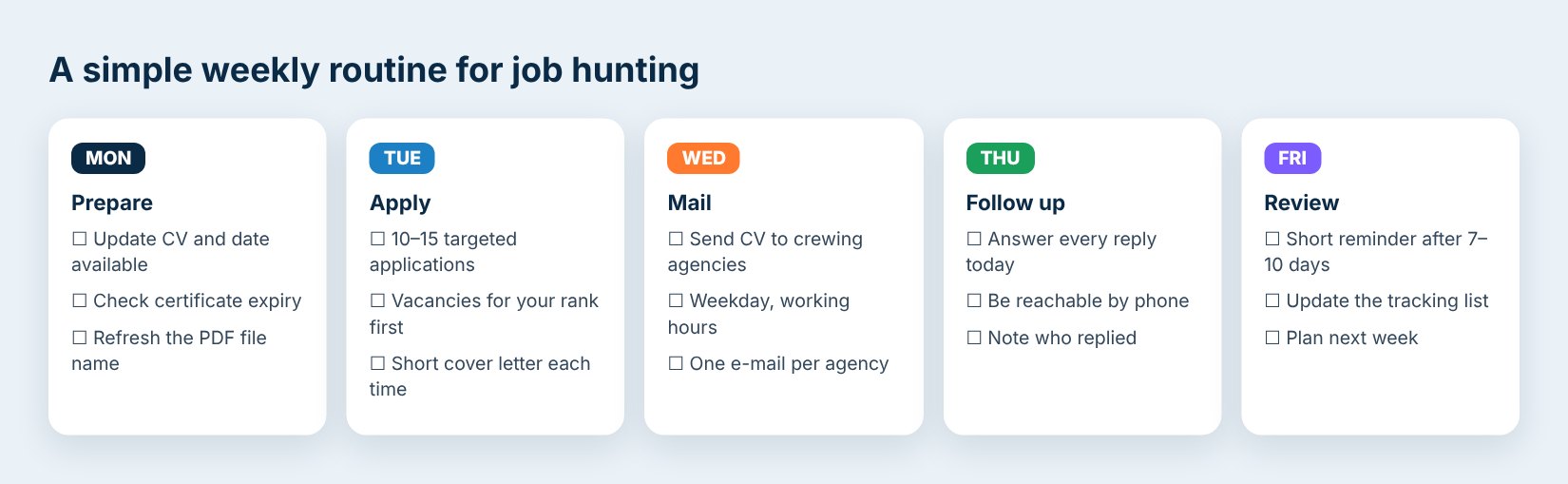
- Monday. Update your CV and date available, check certificate expiry dates.
- Tuesday. Apply to 10–15 vacancies for your rank, each with a short cover letter.
- Wednesday. Send your CV to crewing agencies during working hours.
- Thursday. Answer all messages and calls on the day they arrive.
- Friday. Remind those who have not replied within 7–10 days and note the results of the week.
How to keep track of applications
Start a simple table: date, company, rank, contact person, what you sent, whether they replied, when to remind. After two weeks you will see which channels give replies, which version of the CV works better and whom to remind. Without a record it is easy to write to the same company twice or forget those who asked for documents.
How to recognise scammers
- They ask for money for "employment", a "guarantee" or "document preparation". Under MLC 2006 a seafarer does not pay for finding a job.
- They promise a contract without an interview and without checking documents.
- They send a contract in the name of a well-known company but from a free e-mail domain.
- They rush and pressure: "places run out today".
- They ask for bank card details, passwords or SMS codes.
- They demand documents be sent to a personal number with no confirmation from the company.
If something raises doubt, find the company's official website yourself (not through a link from the e-mail) and call the recruitment department.
What to consider when choosing vacancies
- Vessel type and trading area. Do they suit your experience and visas?
- Contract length and relief schedule. Contracts range from a few weeks to nine months and longer.
- Pay and conditions. What is included: basic wage, overtime, bonuses, tickets, insurance.
- Flag and company. Reputation, conditions on board, crew feedback.
- Documents. Do you have all the endorsements the vacancy requires on the sign-on date?
How to adjust your strategy to your experience
If you are just starting. Cadets and ratings without experience have the hardest time: many vacancies require service. Rely on practice placements and training institutions, cadet programmes of large companies and recommendations from teachers. State everything you have: diploma, STCW courses, practice, English. Apply for Ordinary Seaman, Wiper and Trainee positions and be sure to say that you can join quickly and are open to any contract at the start of your career.
If you are an experienced specialist. For officers and engineers the key is hitting the request exactly. Track vacancies by rank and vessel type, update your profile and keep in touch with the recruiters you have already worked with. The rarer your specialisation (DP, gas carriers, offshore cranes, ice voyages), the better a direct approach to niche agencies works.
If you are returning after a break. Explain the gap in the CV and in the letter in one sentence, say that your documents are valid and stress your fresh preparation: courses, ECDIS, renewed endorsements. The recruiter needs to see that you are ready to work, not only that you have past service.
Seasonality and timing
Hiring goes on all year round, but its intensity changes: there are more vacancies before navigation seasons, after holidays and during mass crew changes. Do not postpone mailing until your contract has already ended: send the CV one or two months before your date available. Agencies build lists in advance and more willingly take those who plan their joining ahead.
Summary
A combination works best: an up-to-date CV, a profile on one or two platforms, subscriptions to job channels, personal e-mails to agencies and contacts with colleagues. Start with the CV: how to write it and how recruiters read it. Then prepare a cover letter and start sending.
Frequently asked questions
Where can I look for a job on a ship?
On professional platforms (LinkedIn, Maritime Zone, Crewell, Indeed), on shipping company websites, at crewing agencies, in job channels and through acquaintances. A combination of several channels works best.
Do I have to pay to get a job on a ship?
No. Under the MLC 2006 convention a seafarer must not pay for help in finding employment. A request for money for a “place” or a “contract guarantee” is a sign of fraud.
How quickly will I get a reply to my CV?
It varies: sometimes within a day, sometimes after a few weeks or months, when a suitable vacancy opens. If there is no reply, remind them after 7–10 days.
How many CVs should I send?
The more companies you reach, the higher the chance that one of them has a suitable vacancy open right now. Each e-mail should be separate, with a proper subject and an up-to-date CV.