When you send your CV to a crewing agency, it feels as if it will be read carefully from the first line to the last. In reality it is different. A crewing manager has several owners' vacancies open at once, dozens of new e-mails a day and urgent replacements: somebody's contract ended unexpectedly, someone fell ill, someone's visa was not extended. CVs have to be scanned on the go. Knowing exactly how they are read lets you put the right facts where they will be noticed.
Who reads your CV
Usually it is not the shipowner but an employee of the crewing company (crewing manager, recruiter, crew coordinator). Their task is to find candidates that match the owner's requirements: rank, time in rank, vessel type, certificates, nationality, age and sometimes previous experience with a particular company. A short list is then sent to the shipowner, who decides or arranges an interview.
So the recruiter works as a filter: they need to rule out unsuitable candidates quickly without missing suitable ones. A CV that immediately answers the filter's questions goes forward. A CV in which the answers have to be searched for is often closed.
The first ten seconds
On the first pass a recruiter does not read the text line by line but checks a few places in a set order. If all of them are "green", they read on. If any of them raises a question, the CV is put aside.
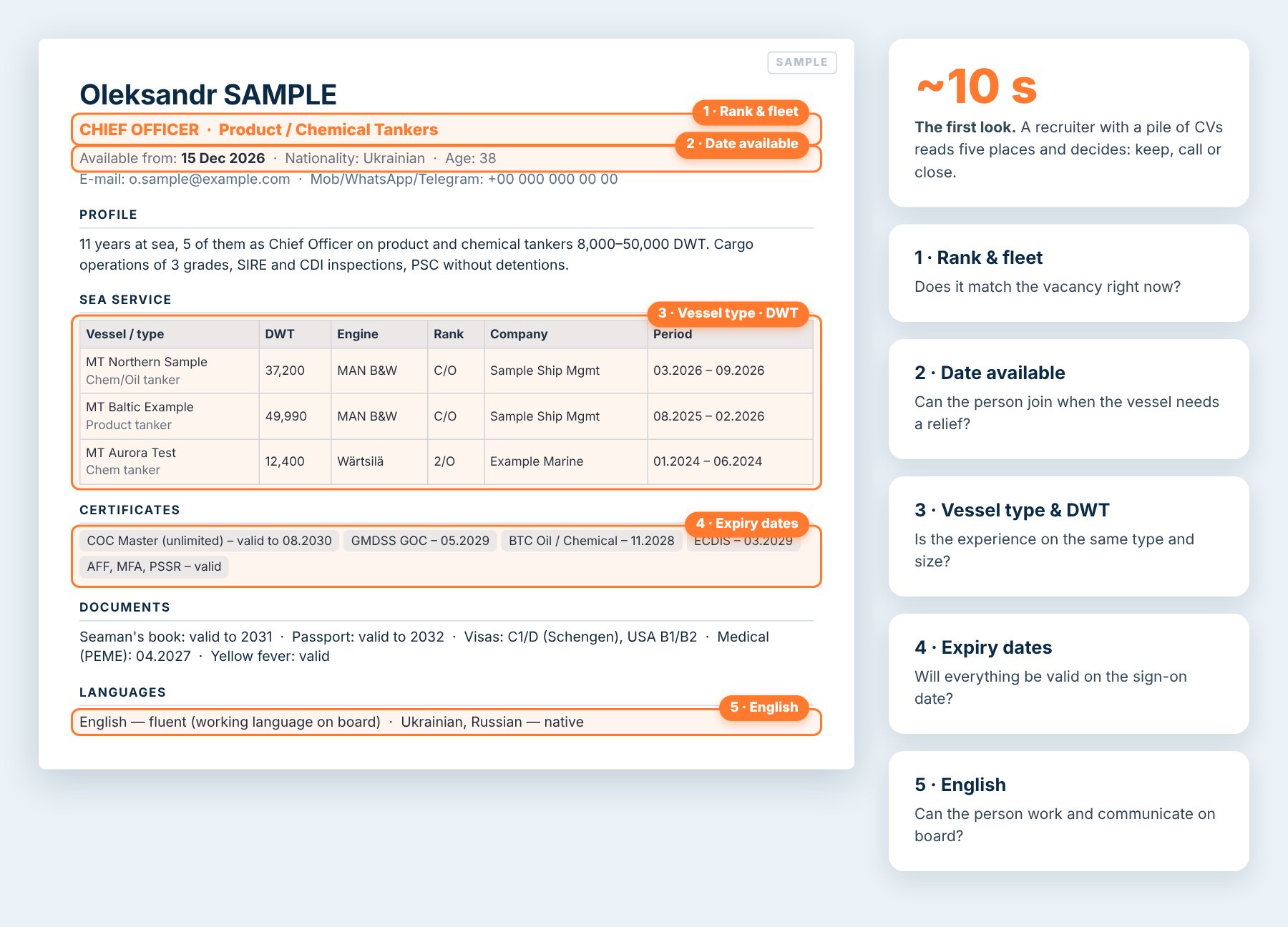
- Rank and fleet. Do they match the open vacancy? If the vacancy is for a tanker Chief Officer and the header says "Master / Chief Officer / 2nd Officer, any fleet", the CV looks undecided.
- Date available. Can you join when the relief is needed? Few people are ready to wait for a candidate who will be free in three months.
- Vessel type and size. Is there experience on the same type and on vessels of a comparable size? For some owners this is a hard requirement.
- Expiry dates. Will everything be valid on the sign-on date?
- English. Will the person be able to work in an international crew and communicate with port authorities and inspectors?
How a recruiter selects candidates step by step
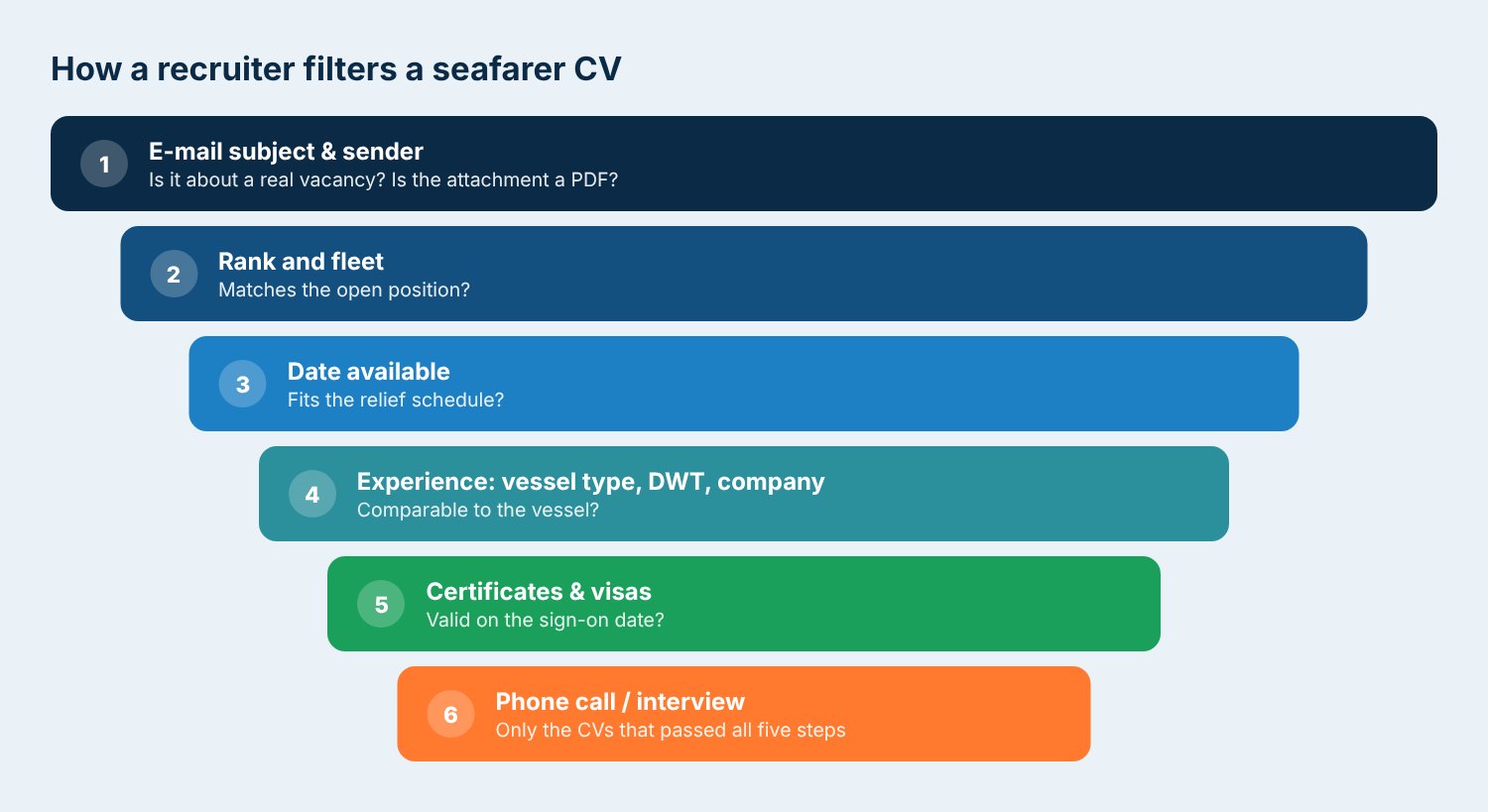
Step 1. The e-mail and the attachment
Before the CV is even opened, the subject line and the file name do the work. If the subject is "CV" or "Job", the e-mail can drown among hundreds of others. A subject like "Chief Officer / Tankers / Ivanov Dmytro / available 15.12.2026" can be read without opening the e-mail. A file named Chief_Officer_Ivanov_CV.pdf is easy to find in the mailbox and in a folder on the computer. More about this in "How to e-mail crewing agencies".
Step 2. Rank and fleet
The recruiter compares the CV with the vacancy requirements. For example, an owner is looking for a Second Engineer for a chemical tanker with a MAN B&W engine and at least two years in rank. If you have one year in rank and that is not visible straight away, you may be filtered out or, the other way round, invited for a call in vain, wasting both sides' time.
Step 3. Date available
Crew changes are planned in advance but are often urgent. A candidate ready to join "within two weeks" is worth more than one whose date is not stated. If you are still on contract, give an approximate sign-off date and note that it may shift.
Step 4. Experience: vessel type, size, company
The recruiter reviews the last two or three contracts. They need to see the vessel type, DWT or GT, engine, your rank and the period. Company names matter too: many owners prefer people who worked for reputable companies, or who have sailed with them before. If there are gaps in the table, explain them briefly and honestly.
Step 5. Certificates and visas
Here licences, COC, STCW, tanker endorsements, medical and visas are checked. An expired document is not always a rejection, but it requires an extra conversation, and the recruiter has little time. It is better to state at once that the document is being renewed, with a date.
Step 6. A call or an interview
Only CVs that passed the previous checks get this far. On the call they check English, motivation, contract details and readiness to join. So your phone must be on and your messenger available. If you missed a call, call back or write within an hour: vacancies close fast.
What a recruiter sees as "green flags"
- Rank and date available in the first two lines.
- Experience on similar vessels and in a similar rank, a clear table of contracts.
- A clear timeline: contract, leave, contract.
- Certificates with numbers and dates, no expired documents.
- A one- or two-page PDF that reads well on a phone.
- Contacts: e-mail, phone, messenger.
- Stability: several contracts with one company can be a plus.
What raises doubts
- No date available. The recruiter cannot quickly tell whether the candidate fits.
- An unclear fleet or vessel types. "Any vessel" reads as a lack of specialisation.
- Too frequent changes of company. Several contracts of two or three months with different companies without explanation.
- Long unexplained pauses. Especially in the last year or two.
- Inconsistencies. For example, one place says Third Officer while another shows Chief Officer service for the same dates.
- Many spelling mistakes. They are read as carelessness with documents, which is critical on board.
- A scanned CV or a photo of a document. The text cannot be selected or found in the database.
How a recruiter searches their database
Many agencies keep CVs in a spreadsheet or special software and search by keywords: "Chief Officer", "Tanker", "ECDIS", "DP", "Bosun". So use the standard terms the way they are written in vacancies. Write Chief Officer rather than a local translation of the rank, and COC or Certificate of Competency for your licence. Text matters for search: the CV should be a PDF with selectable text, not an image.
Your CV may be found months after you sent it, when a suitable vacancy opens. So do not delete the e-mail thread after sending, and update the CV whenever your date or certificates change: outdated information in a recruiter's database may not bring you back.
Document checks and references
If you pass the initial selection, the recruiter may ask for scans of your licences and certificates, seaman's book and visa. The authenticity of documents is usually checked with the issuing authority and sometimes through online databases. Any inaccuracy in dates or numbers will surface immediately. They may also call a previous company, so it helps to agree in advance with one or two former masters or chief engineers who are ready to give a reference.
Example: two candidates with the same experience
Imagine two Second Engineers with the same experience on chemical tankers. The first has no date in the header, service described in one paragraph, no engine data and certificates without expiry dates. The second has "2nd Engineer, chemical tankers, available 20.12.2026", a contract table with engines and power, and certificates with dates. A recruiter who has ten minutes for twenty CVs will call the second. Not because he is better, but because he is easier to verify.
What to do right now
- Open your CV and give yourself ten seconds. Find your rank, date available, last vessel type, certificate expiry dates and English. If you could not find something, move it higher.
- Check that the file is a PDF with text, not a scan, and that the file name contains your rank and surname.
- Update dates and certificates and remove anything expired.
- Prepare a short cover letter: how to write it.
- Make sure you can be reached by phone and messenger.
How to build a CV from scratch is explained in detail in "How to write a seafarer CV". And if you need to send it quickly to many companies, CV-Sender mailing will send your CV and cover letter to the crewing database on the date you choose.
Frequently asked questions
How much time does a recruiter spend on one seafarer CV?
The first look takes a few seconds: the recruiter checks the rank, date available, vessel type, document expiry dates and English. Only CVs that pass this check are read in detail.
What do recruiters check first in a seaman's CV?
Rank and fleet, date available, experience on the same vessel type, validity of certificates and visa, English level and contact details.
Why does a recruiter not reply to my CV?
There can be many reasons: no suitable vacancy, a mismatch of rank or vessel type, or the main answers were not found in the CV. Often a CV is simply saved to the database and revisited when a suitable vacancy opens.
Should I send my CV again?
If your date available, certificates or contacts have changed — yes. If nothing has changed, a short reminder after a week or two is enough.
Can I send a CV in Word format?
A PDF is better: it looks the same on any device and is less often blocked by mail filters. The text in the PDF should be selectable, not a scanned picture.