How to Write a Seafarer CV: Structure, Tips and Common Mistakes
Crewing agencies receive dozens of CVs every day and scan them quickly. A good seaman CV answers the key questions within seconds: who you are, when you are ready to join, and what vessels you have served on.
A seafarer's CV is not a life story — it is a working document. It is read by a person who is solving a specific task: finding a Chief Officer, a Second Engineer or a Bosun for a vessel by a certain date. If they do not find the key facts within the first seconds, they move on to the next CV. Below is a detailed guide to building a CV that passes that first look and gets you a phone call.
What structure works
A seafarer CV has an established order of blocks. Recruiters and crewing managers are used to it, so they find the right information automatically without reading every line. A non-standard "creative" layout only gets in the way.
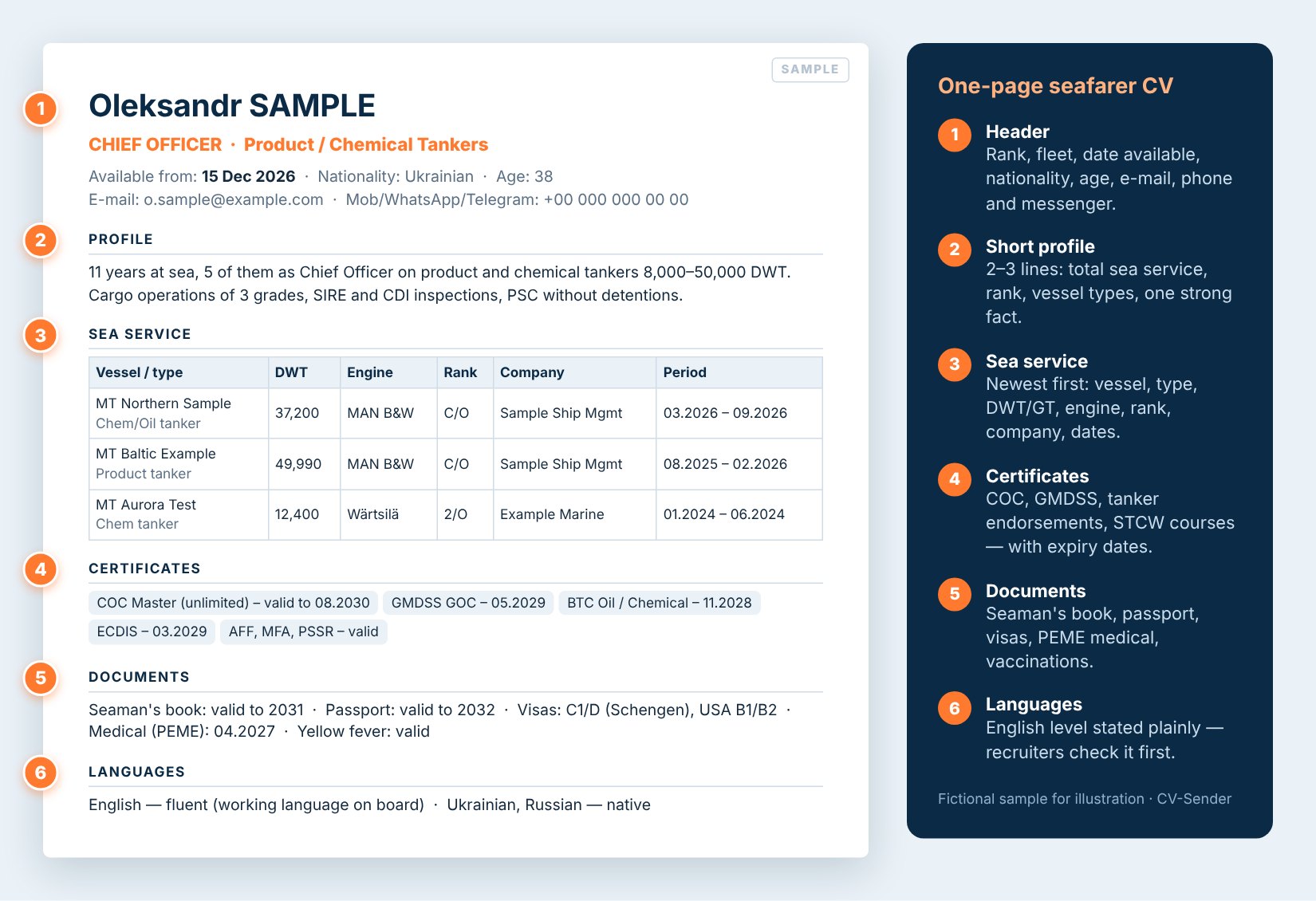
- Header. Name, rank, fleet, date available, nationality, age, e-mail, phone and messenger.
- Short profile. 2–3 lines about who you are as a professional.
- Sea service. A table of vessels from the latest to the earliest.
- Certificates. With numbers and expiry dates.
- Documents. Seaman's book, passport, visas, medical, vaccinations.
- Languages. Above all, your English level.
1. Header: the essentials in the first lines
The top of the page must answer three questions: which rank you apply for, when you can join and how to reach you. Write the rank the way crewing departments call it: Chief Officer, 2nd Engineer, Able Seaman, Bosun. There is no need for "experienced captain of ocean-going vessels" — Master is enough.
Next to the rank, name the fleet or vessel types you want to work on: tankers, bulk carriers, container ships, offshore. If you are open to several, list them separated by commas, but do not write "any vessel". Recruiters look for a specific specialist, and a universal wording reads as lack of experience.
Date available is one of the most important items. If you are free now, write "Available now" or a specific date. If you are finishing a contract, give the expected sign-off date. A CV without a date is often put aside "for later" and then forgotten.
Contacts: a professional e-mail without nicknames (name.surname works well), a phone number with the country code and a messenger where you actually reply — WhatsApp, Telegram or Viber. A crewing manager often picks the candidate who can be reached within five minutes.
2. Short profile: two or three sentences that matter
It is not "responsible, sociable, stress-resistant". Those words prove nothing. Put facts there: total sea service, time in the current rank, vessel types, one notable result.
11 years at sea, 5 of them as Chief Officer on chemical tankers of 8,000–50,000 DWT. Cargo operations with three grades, SIRE and CDI inspections, PSC without detentions.
Such a line shows your level straight away. If your experience is still small, say so honestly and focus on your training: "Graduated from a maritime university, internship on a bulk carrier, OOW licence".
3. Sea service: the core of your CV
This table is where the recruiter checks whether you fit the vessel. List contracts from the latest to the earliest. Each line needs:
- the vessel name and type (bulk carrier, chemical tanker, container ship, AHTS, PSV);
- size: DWT for cargo ships, GT for the rest; for offshore — power and DP class;
- the main engine (a must for engineers: make and power);
- your rank on that vessel;
- the company that employed you (manning agency or shipowner);
- contract dates as "month.year – month.year".
If you were promoted, show it clearly — it proves that you are trusted. Gaps between contracts are better explained briefly: "leave", "training", "shore job". An unexplained pause of a year or more raises questions.
For senior officers add short lines about responsibility: cargo types, special voyages, ice navigation experience, work with ECDIS and DP. For engineers, details on automation, repair work, engine types and auxiliary equipment are useful.
4. Certificates: numbers and expiry dates
In this block the recruiter checks whether each document is valid on your sign-on date. So give not only the name but also the number, the issuing country and the expiry date. A simple table is enough.
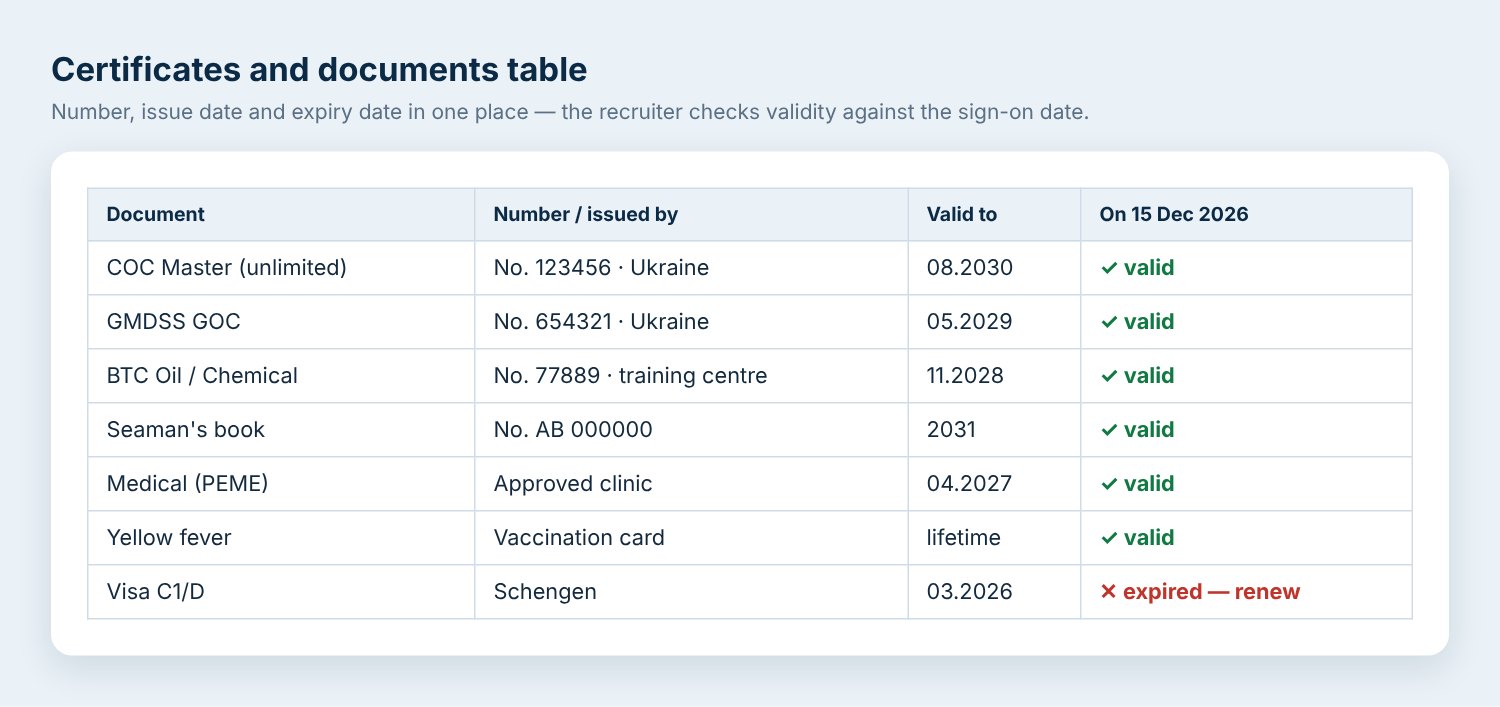
Usually you list:
- your licence and its endorsement (COC, flag state endorsement if applicable);
- GMDSS (GOC or ROC);
- basic STCW training: personal survival, fire prevention and fire fighting, first aid, personal safety and social responsibility (PSSR);
- advanced courses: Advanced Fire Fighting, Medical First Aid or Medical Care, rescue boats;
- tanker endorsements (oil, chemical, gas) if you work on tankers;
- ECDIS, BRM, ERM, DP, ISPS/SSO and other specialist courses for your profile.
Do not clutter this section with outdated or irrelevant courses. A certificate that you took ten years ago and that is no longer valid is better removed.
5. Documents: seaman's book, visas, medical
State which documents you hold and until when they are valid: seaman's book, passport, visas (for example C1/D, US), medical certificate (PEME) and vaccinations required for voyages to certain regions. If a visa has expired, do not hide it — say that you are renewing it. A hidden expiry will come out sooner or later and spoil the impression.
6. Languages
English is the working language on board. Say it directly: "English — fluent", "upper-intermediate", "working level". Do not overstate: in a phone interview the level quickly becomes obvious. If you have a certificate (IELTS, Maritime English), add it.
Photo, age and personal data
A photo in formal clothes on a light background is customary in seafarer CVs, but not mandatory. If you add one, make it business-like, not a holiday snapshot. Age and nationality are normally stated because they affect visas and owners' requirements. Marital status, children and a home address are not needed: a city and a country are enough. Salary expectations are usually not given in a CV: if an agency asks, answer in your e-mail.
Length and file format
One page is ideal, two is the maximum for a long service record. Save as PDF so that the layout does not break on a recruiter's phone. Give the file a clear name: Chief_Officer_Ivanov_CV.pdf, not "cv_final2". Keep the size under 1–2 MB, otherwise the e-mail may be stopped by mail filters. Use a plain font, 10–11 pt, with no coloured backgrounds across the whole page.
How to adapt the CV to the rank and fleet
- Deck officers. Cargo type, vessel sizes, ECDIS, ice experience, tanker endorsements, participation in inspections (PSC, SIRE, CDI, vetting).
- Engineers. Make and power of the main engine, fuel type, UMS experience, repairs at sea, management systems (ISM, PMS), and for gas carriers the IGF endorsement.
- Ratings. Vessel type, what exactly your duties included, AB or motorman certificate, experience in mooring, working aloft and in enclosed spaces.
- Electricians and ETOs. Automation, high-voltage systems, navigation and communication equipment.
- Cooks and stewards. Crew size, cuisines, experience on vessels of different flags, hygiene certificates.
- Offshore. DP class, vessel types (AHTS, PSV, CSV), crane operation, emergency survival certificates.
It is better to keep several versions of the CV: a general one, a tanker one and an offshore one. Adjusting the wording for a specific vacancy takes ten minutes and noticeably improves the chance of a reply.
Common mistakes
- No date available. The recruiter does not know whether you fit the relief schedule.
- No vessel type and DWT. Your experience cannot be assessed.
- No messenger contacts. A quick call or message is not possible.
- Expired certificates. A single expired document often removes a candidate from the list.
- A long "about me" story. General words instead of facts.
- Mixed date styles. A mix of "03/26", "March 2026" and "2026-03" is hard to read.
- Mistakes in vessel and company names. A recruiter can check them in public databases.
- A file that is not a PDF or has an unclear name. It may open incorrectly or get lost in a mailbox.
Checklist before you send
- Rank and fleet are in the header, the date available is current.
- Contacts work: you have tested the e-mail and the phone number yourself.
- Sea service starts from the latest contract; each vessel has a type, size and engine.
- All certificates are valid on the sign-on date.
- The CV fits one or two pages and is saved as a PDF.
- The file is named like "Rank_Surname_CV.pdf".
- A short cover letter is ready — see "Cover letter for seafarers".
What to do next
When the CV is ready, it has to reach the people who hire. How such documents are read is covered in "How recruiters read a seafarer CV", and how to write to an agency in "How to e-mail crewing agencies". For fresh offers, see the seafarer jobs page.
If you need your CV put in order quickly, we will write it for your rank and vessel types — order a CV.
Frequently asked questions
How long should a seafarer CV be?
One page, two at the most. What matters is sea service by vessel, certificates and the date available. If your service is long, describe the last 5–7 years in detail and shorten the earlier ones.
Should I put a photo on a seaman's CV?
A photo in formal clothes is customary but not mandatory. Many agencies request it separately. If you add one, keep it business-like.
Which file format is better: Word or PDF?
PDF. The layout does not break on the recruiter's phone or computer, and the file is smaller. Keep the Word version for editing.
What if I have little experience?
Say so honestly and focus on your diploma, STCW courses, cadet practice and internships. Give the date available and your readiness to join quickly.
Do I need to translate my CV into English?
Yes. International crewing agencies and shipowners work in English, so your main CV should be in English. Use the standard names of ranks and certificates.